Each bathroom has its own exhaust fan.
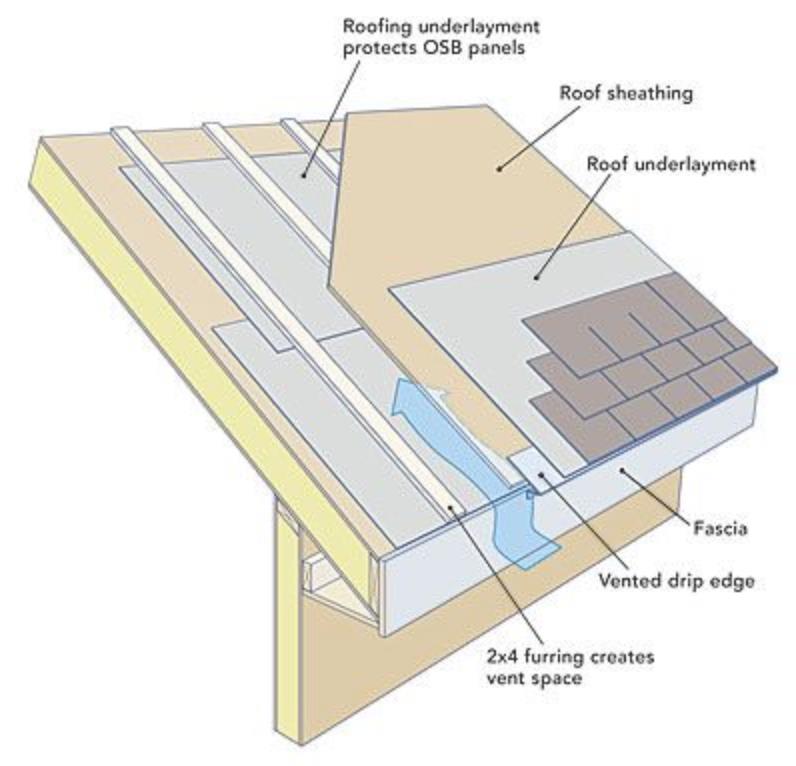
Run bathroom duct through roof or underhang.
And while both a roof vent and an overhang vent perform this task there is one big difference.
Whether it s new construction or a remodel a bathroom vent should always vent through the roof instead of an eave overhang or soffit.
In order to accomplish this the roof has to have a hole cut in it.
The point of a bathroom exhaust vent or any vent really is to remove hot moist air from the house.
This involves running ductwork from the fan usually though an attic and out through the roof.
The 2nd bathroom vent drips on the floor and is ruining the ceiling.
Bath vent fan slope.
The master bathroom and the 2nd bathroom vent through the roof and through the same opening.
It is because of this that many builders tend to advise against this method.
From up on the roof use a jigsaw or reciprocating saw to cut a 4 in.
Attics can be problematic when insulation is located in the attic floor rather than in the rafter bays or better yet outside the roof sheathing.
The 2 pipes one a 4 master and the other a 3 2nd do not go through the ceiling but into a common box that goes through the roof.
And of course a bathroom with a window doesn t require an exhaust vent.
Depending on the location of the bathroom it may be easy to vent the exhaust fan through the roof.
Each fan vents separately out the roof.
Fantec makes some nice remote fan systems virtually silent in operation and you only need one fan for the 2 or more bathrooms.
This is typically the case for ducts that run through a dropped ceiling or soffit or between joists so long as the floor system sits on top of a conditioned basement or crawlspace.
Both bathrooms are vented by a single in line fan that has one exhaust vent running through the roof.
This article series explains how to install bathroom exhaust fans or vents the vent ducting the vent termination at the wall soffit or roof vent fan wiring bath vent duct insulation bath vent lengths clearances routing and we answer just.
This article describes the recommended slope direction on bath exhaust fan ducts to avoid icing and related building leaks.
Hot air likes to rise venting through the roof is the shortest path so it has the least possibility of condensation and shorter runs are more efficient.
Try to keep it close to the fan location.
Leave the drill bit sticking through the roof so you can find the hole.
An exhaust vent fan can exhaust out through a gable end side wall or out through a soffit overhang.
One in line centrifugal fan can be mounted in the attic to exhaust the moisture from two bathrooms.
More often bathroom fans vent out through a duct running up to the roof.